| |
Date |
Event(s) |
| 1 | 1509 | - 22 Apr 1509—28 Jan 1547: The Reign of King Henry VIII
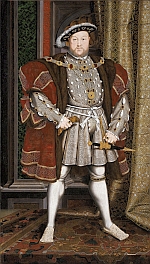
Henry VIII (28 June 1491 – 28 January 1547) was King of England from 22 April 1509 until his death in 1547. Henry is best known for his six marriages, and for his efforts to have his first marriage (to Catherine of Aragon) annulled. His disagreement with Pope Clement VII about such an annulment led Henry to initiate the English Reformation, separating the Church of England from papal authority. He appointed himself Supreme Head of the Church of England and dissolved convents and monasteries, for which he was excommunicated by the pope.
Marriages:
Catherine of Aragon m. 1509
Anne Boleyn m. 1533
Jane Seymour m. 1536
Anne of Cleves m. 1540
Catherine Howard m. 1540
Catherine Parr m. 1543
|
| 2 | 1547 | - 28 Jan 1547—6 Jul 1553: The Rein of King Edward VI
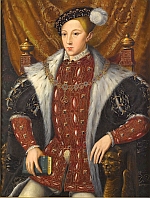
Edward VI (12 October 1537 – 6 July 1553) was King of England and Ireland from 28 January 1547 until his death in 1553. He was crowned on 20 February 1547 at the age of nine.[1] Edward was the son of Henry VIII and Jane Seymour and the first English monarch to be raised as a Protestant.[2] During his reign, the realm was governed by a regency council because he never reached maturity. The council was first led by his uncle Edward Seymour, 1st Duke of Somerset (1547–1549), and then by John Dudley, 1st Earl of Warwick (1550–1553), who from 1551 was Duke of Northumberland.
|
| 3 | 1553 | - Jul 1553—17 Nov 1558: The Rein of Queen Mary I
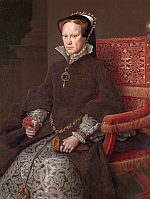
Mary I (18 February 1516 – 17 November 1558), also known as Mary Tudor, and as "Bloody Mary" by her Protestant opponents, was Queen of England and Ireland from July 1553 and Queen of Spain as the wife of King Philip II from January 1556 until her death in 1558. She is best known for her vigorous attempt to reverse the English Reformation, which had begun during the reign of her father, Henry VIII. Her attempt to restore to the Church the property confiscated in the previous two reigns was largely thwarted by Parliament, but during her five-year reign, Mary had over 280 religious dissenters burned at the stake in the Marian persecutions.
|
| 4 | 1558 | |
| 5 | 1564 | - 26 Apr 1564—23 Apr 1616: William Shakespeare is born
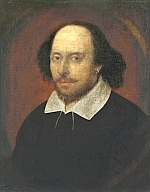
William Shakespeare was an English playwright, poet and actor. He is widely regarded as the greatest writer in the English language and the world's pre-eminent dramatist. He is often called England's national poet and the "Bard of Avon" (or simply "the Bard"). His extant works, including collaborations, consist of some 39 plays, 154 sonnets, three long narrative poems, and a few other verses, some of uncertain authorship. His plays have been translated into every major living language and are performed more often than those of any other playwright.
|
| 6 | 1603 | - 24 Mar 1603—27 Mar 1625: The Reign of King James I
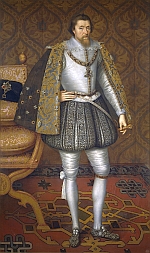
James VI and I (James Charles Stuart; 19 June 1566 – 27 March 1625) was King of Scotland as James VI from 24 July 1567 and King of England and Ireland as James I from the union of the Scottish and English crowns on 24 March 1603 until his death in 1625. Although he wanted to bring about a closer union, the kingdoms of Scotland and England remained individual sovereign states, with their own parliaments, judiciaries, and laws, both ruled by James in personal union.
James was the son of Mary, Queen of Scots
|
| 7 | 1620 | - 9 Nov 1620: The Mayflower arrives in America

On September 6, the Mayflower departed from Plymouth, England, and headed for America. The voyage itself across the Atlantic Ocean took 66 days, from their departure on September 6, until Cape Cod was sighted on 9 November 1620. The colonists spent that first winter living onboard the Mayflower.
Of the 102 passengers on the ship, which was 80 feet long and 24 feet wide, only 53 passengers and half the crew survived. Women were particularly hard hit; of the 19 women who had boarded the Mayflower, only five survived.
The Plymouth Colony is formed until 1685 when it is split into three counties: Plymouth, Barnstable, and Bristol
Caleb Johnson's Mayflower History
|
| 8 | 1630 | - 7 Sep 1630: The Town of Watertown, Massachusetts is Incorporated
In July of 1630, Sir Richard Saltonstall and Reverend George Phillips and others from the Winthrop fleet row up the river from Charlestown and settle Watertown.
In September, the settlement is officially incorporated into the Massachusetts Bay Colony as Watertown.
In 1665 The Old Burying Ground is established on what is now modern day Arlington Street.
On July 19, 1776 the Treaty of Watertown is signed at the Edmund Fowle House. The treaty establishes a military alliance between the United States and the St. John’s Indians and some of the Mi’kmaw bands against Great Britain in the Revolutionary War.
|

 Abt 1543 - 1601 (58 years)