| |
Date |
Event(s) |
| 1 | 1706 | - 17 Jan 1706—17 Apr 1790: Benjamin Franklin is born
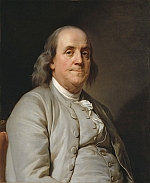
Benjamin Franklin was an American polymath who was active as a writer, scientist, inventor, statesman, diplomat, printer, publisher, forger and political philosopher. Among the leading intellectuals of his time, Franklin was one of the Founding Fathers of the United States, a drafter and signer of the United States Declaration of Independence, and the first United States Postmaster General.
|
| 2 | 1773 | - 16 Dec 1773: Boston Tea Party
The Boston Tea Party was an American political and mercantile protest by the Sons of Liberty in Boston, Massachusetts, on December 16, 1773. The target was the Tea Act of May 10, 1773, which allowed the British East India Company to sell tea from China in American colonies without paying taxes apart from those imposed by the Townshend Acts. The Sons of Liberty strongly opposed the taxes in the Townshend Act as a violation of their rights. Protesters, some disguised as Indigenous Americans, destroyed an entire shipment of tea sent by the East India Company.
|
| 3 | 1775 | - 1775: The Flush Toilet is Invented
In 1775 Scottish inventor Alexander Cumming was granted the first patent for a flush toilet. His greatest innovation was the S-shaped pipe below the bowl that used water to create a seal preventing sewer gas from entering through the toilet.
- 19 Apr 1775—3 Sep 1783: American Revolutionary War
The American Revolutionary War, also known as the Revolutionary War or American War of Independence, was a major war of the American Revolution. Widely considered as the war that secured the independence of the United States, fighting began on April 19, 1775, followed by the Lee Resolution on July 2, 1776, and the Declaration of Independence on July 4, 1776. The American Patriots were supported by the Kingdom of France and, to a lesser extent, the Kingdom of Spain and the Dutch Republic, in a conflict taking place in North America, the Caribbean, and the Atlantic Ocean.
|
| 4 | 1776 | - 4 Jul 1776: The United States Declaration of Independence is signed
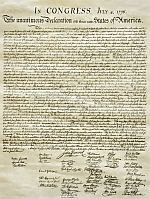
The United States Declaration of Independence, officially The unanimous Declaration of the thirteen united States of America, is the pronouncement and founding document adopted by the Second Continental Congress meeting at Pennsylvania State House, which was later renamed Independence Hall, in Philadelphia, Pennsylvania, on July 4, 1776. Enacted during the American Revolution, the Declaration explains why the Thirteen Colonies at war with the Kingdom of Great Britain regarded themselves as thirteen independent sovereign states and no longer subject to British colonial rule. With the Declaration, the 13 states took a collective first step in forming the United States and, de facto, formalized the American Revolutionary War, which had been ongoing since April 1775.
|
| 5 | 1787 | - 18 Nov 1787—10 Jul 1851: Louis Daguerre is born
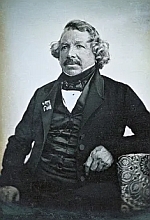
Louis-Jacques-Mandé Daguerre (18 November 1787 – 10 July 1851) was a French artist and photographer, recognized for his invention of the eponymous daguerreotype process of photography. He became known as one of the fathers of photography. Though he is most famous for his contributions to photography, he was also an accomplished painter, scenic designer, and a developer of the diorama theatre.
|
| 6 | 1789 | |
| 7 | 1794 | - 14 Mar 1794: The Cotton Gin is Invented
Designed to separate cotton fiber from seed, Eli Whitney's cotton gin, for which he received a patent on March 14, 1794, introduced a new, profitable technology to agricultural production in America. The cotton gin is a device for removing the seeds from cotton fiber.
|
| 8 | 1796 | - 1796: Smallpox vaccine developed
The smallpox vaccine is the first vaccine to be developed against a contagious disease. In 1796, British physician Edward Jenner demonstrated that an infection with the relatively mild cowpox virus conferred immunity against the deadly smallpox virus. Not everyone was on board with Jenner and his vaccine. Rumors circulated at the time that it would turn people into cows. But by 1801, through extensive testing, it was shown to effectively protect against smallpox
In Jenner’s time, smallpox killed around 10 percent of the population, with the number as high as 20 percent in towns and cities where infection spread more easily. In 1821 he was appointed physician extraordinary to King George IV
The last natural outbreak of smallpox in the United States occurred in 1949.
|
| 9 | 1797 | |
| 10 | 1801 | |
| 11 | 1809 | - 4 Mar 1809—4 Mar 1817: President James Madison
4th President of the United States. Born Mar. 16, 1751. Died Jun. 28, 1836 at the age of 85.
|
| 12 | 1812 | - 7 Feb 1812: Charles Dickens is born
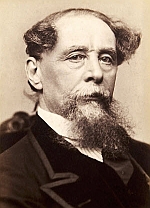
Charles John Huffam Dickens was an English writer and social critic. He is famous for his novels that touch upon the sensitive issues of poverty, child labour, and slavery. Some of the books he is known for are Oliver Twist, David Copperfield, A Tale of Two Cities, and Great Expectations.
- 18 Jun 1812—17 Feb 1815: War of 1812
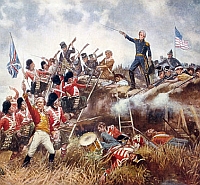
The War of 1812 was a conflict fought between the United States and the United Kingdom, and their respective allies from June 1812 to February 1815. Historians in Britain often see it as a minor theater of the Napoleonic Wars; in the United States and Canada, it is seen as a war in its own right.
Peace negotiations began in August 1814, and the Treaty of Ghent was signed on December 24. News of the peace did not reach America for some time. Unaware of the treaty, British forces invaded Louisiana and were defeated at the Battle of New Orleans in January 1815. These late victories were viewed by Americans as having restored national honour, leading to the collapse of anti-war sentiment and the beginning of the Era of Good Feelings, a period of national unity. News of the treaty arrived shortly thereafter, halting military operations. The treaty was unanimously ratified by the US Senate on February 17, 1815, ending the war with no boundary changes.
|
| 13 | 1815 | - 10 Dec 1815: Ada Lovelace is born
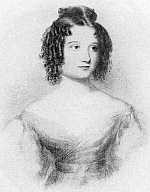
Augusta Ada King, Countess of Lovelace (née Byron) was an English mathematician and writer, known for her work on Charles Babbage's mechanical general-purpose computer, the Analytical Engine. She was the first to recognise that the machine had applications beyond pure calculation, and published the first algorithm intended to be carried out by such a machine. As a result, she is sometimes regarded as the first to recognise the full potential of a "computing machine" and the first computer programmer.
Lovelace was the only legitimate child of the poet Lord Byron and his wife Anne Isabella "Annabella" Milbanke, Lady Wentworth. Ada translated an article by Italian military engineer Luigi Menabrea, on the Babbage engine, supplementing it with a set of notes, which contain what many consider to be the first computer program, an algorithm designed to be carried out on the engine, if it had ever been built.
|
| 14 | 1817 | |
| 15 | 1818 | - 1818—20 Feb 1895: Frederick Douglass is born
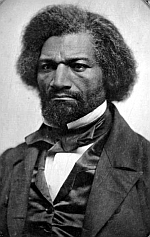
Born into slavery, he successfully escaped 3 Sep 1838. He was a Social reformer, author and orator. Leader in US abolitionist movement. Supported women’s rights movement. Became licensed preacher (1839). Publisher and editor, The North Star (1847-1851), later Frederick Douglass’ Paper (1851-1860). Publisher and editor, the New National Era (1870). Nominated for Vice-President by the Equal Rights Party (1872). Appointed President, Freedmen’s Savings Bank (1874). Served as US Ambassador to Haiti (1889-1891). Works include: Narrative of the Life of Frederick Douglass, an American Slave (1845); My Bondage and My Freedom (1855); and Life and Times of Frederick Douglass (1st ed., 1881, revised, 1892).
|
| 16 | 1820 | - 12 May 1820: Florence Nightingale is born
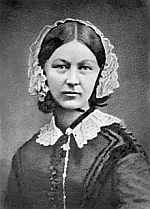
Florence Nightingale, (12 May 1820 – 13 August 1910) was an English social reformer and statistician, and the founder of modern nursing.
Nightingale came to prominence while serving as a manager and trainer of nurses during the Crimean War, in which she organised care for wounded soldiers. She gave nursing a favourable reputation and became an icon of Victorian culture, especially in the persona of "The Lady with the Lamp" making rounds of wounded soldiers at night. In 1860, Nightingale laid the foundation of professional nursing with the establishment of her nursing school at St Thomas' Hospital in London.
|
| 17 | 1822 | - 27 Dec 1822: Louis Pasteur is born
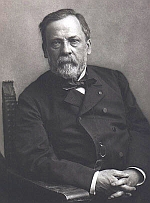
Louis Pasteur (December 27, 1822 – September 28, 1895) was a French biologist, microbiologist and chemist renowned for his discoveries of the principles of vaccination, microbial fermentation and pasteurization. His discoveries have saved many lives. He reduced mortality from puerperal fever, and created the first vaccines for rabies and anthrax. His medical discoveries provided direct support for the germ theory of disease and its application in clinical medicine. He is best known to the general public for his invention of the technique of treating milk and wine to stop bacterial contamination, a process now called pasteurization.
|
| 18 | 1825 | - 4 Mar 1825—4 Mar 1829: President John Quincy Adams
6th President of the United States. Born Jul. 11, 1767. Died Feb. 23, 1848 at the age of 81.
- 27 Sep 1825: World's first public railway to use steam locomotives
The Stockton and Darlington Railway (S&DR) was a railway company that operated in north-east England from 1825 to 1863. The world's first public railway to use steam locomotives, its first line connected collieries near Shildon with Stockton-on-Tees and Darlington, and was officially opened on 27 September 1825. While coal wagons were hauled by steam locomotives from the start, passengers were carried in coaches drawn by horses until carriages hauled by steam locomotives were introduced in 1833.
Many of the earliest locomotives for commercial use on American railroads were imported from Great Britain, including first the Stourbridge Lion and later the John Bull. However, a domestic locomotive-manufacturing industry was soon established. In 1830, the Baltimore and Ohio Railroad's Tom Thumb, designed by Peter Cooper, was the first commercial US-built locomotive to run in America.
|
| 19 | 1826 | - 1826: The World's First Photograph
Joseph Nicéphore Niépce (7 March 1765 – 5 July 1833), was a French inventor, usually credited with the invention of photography. Niépce developed heliography, a technique he used to create the world's oldest surviving product of a photographic process: a print made from a photoengraved printing plate in 1825. In 1826 or 1827, he used a primitive camera (Atlas Obscura) to produce the oldest surviving photograph of a real-world scene. Among Niépce's other inventions was the Pyréolophore, one of the world's first internal combustion engines, which he conceived, created, and developed with his older brother Claude Niépce.
|
| 20 | 1829 | |
| 21 | 1835 | - 30 Nov 1835—21 Apr 1918: Mark Twain is born
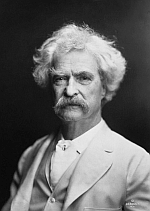
Samuel Langhorne Clemens (November 30, 1835 – April 21, 1910), known by his pen name Mark Twain, was an American writer, humorist, entrepreneur, publisher, and lecturer. He was praised as the "greatest humorist the United States has produced", and William Faulkner called him "the father of American literature". His novels include The Adventures of Tom Sawyer (1876) and its sequel, Adventures of Huckleberry Finn (1884), the latter of which has often been called the "Great American Novel".
|
| 22 | 1845 | - 1845—1855: The Great Famine (or the Irish Potato Famine)
The Great Famine, also known within Ireland as the Great Hunger or simply the Famine and outside Ireland as the Irish Potato Famine, was a period of starvation and disease in Ireland; with the most severely affected areas in the west and south of Ireland. The worst year of the period was 1847. Roughly 1 million people died and more than 1 million fled the country, causing the country's population to fall by 20–25% (in some towns falling as much as 67%) between 1841 and 1871. Between 1845 and 1855, at least 2.1 million people left Ireland, primarily on packet ships but also on steamboats and barques—one of the greatest exoduses from a single island in history.
|
| 23 | 1847 | - 11 Feb 1847—18 Oct 1931: Thomas Edison is born
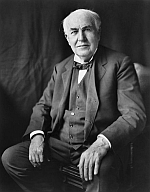
Thomas Alva Edison (February 11, 1847 – October 18, 1931) was an American inventor and businessman. He developed many devices in fields such as electric power generation, mass communication, sound recording, and motion pictures.[4] These inventions, which include the phonograph, the motion picture camera, and early versions of the electric light bulb, have had a widespread impact on the modern industrialized world.
- 3 Mar 1847—2 Aug 1922: Alexander Graham Bell is born
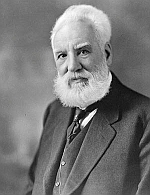
Alexander Graham Bell was a Scottish-born scientist, inventor, engineer, and innovator who is credited with inventing and patenting the first practical telephone. He also founded the American Telephone and Telegraph Company (AT&T) in 1885.
Bell's father, grandfather, and brother had all been associated with work on elocution and speech and both his mother and wife were deaf, profoundly influencing Bell's life's work. His research on hearing and speech further led him to experiment with hearing devices which eventually culminated in Bell being awarded the first U.S. patent for the telephone in 1876. Bell considered his invention an intrusion on his real work as a scientist and refused to have a telephone in his study.
|
| 24 | 1848 | - 1848—1855: California Gold Rush
The California Gold Rush (1848–1855) was a gold rush that began on January 24, 1848, when gold was found by James W. Marshall at Sutter's Mill in Coloma, California. The news of gold brought approximately 300,000 people to California from the rest of the United States and abroad.
|
| 25 | 1852 | - 1852—1860: Cholera pandemic
Generally considered the most deadly of the seven cholera pandemics, the third major outbreak of Cholera in the 19th century lasted from 1852 to 1860. Researchers at UCLA believe may have started as early as 1837 and lasted until 1863. Like the first and second pandemics, the Third Cholera Pandemic originated in India, spreading from the Ganges River Delta before tearing through Asia, Europe, North America and Africa and ending the lives of over a million people.
British physician John Snow, while working in a poor area of London, tracked cases of cholera and eventually succeeded in identifying contaminated water as the means of transmission for the disease.
|
| 26 | 1857 | |
| 27 | 1861 | - 1861: First true bicycle
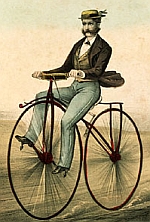
The first true bicycle is invented in France by Ernest Michaux and Pierre Lallement. The Velocipede, often known as the “boneshaker”, was the first bike with pedals (but no brakes!). It was called the “boneshaker” because of its stiff iron frame. This made to a rough and bumpy ride.
- 4 Mar 1861—15 Apr 1865: President Abraham Lincoln
16th President of the United States. Born Feb. 12, 1809. Assassinated Apr 15, 1865 at the age of 56.
- 12 Apr 1861—26 May 1865: American Civil War
The American Civil War was a civil war in the United States. It was fought between the Union ("the North") and the Confederacy ("the South"), the latter formed by states that had seceded. The central cause of the war was the dispute over whether slavery would be permitted to expand into the western territories, leading to more slave states, or be prevented from doing so, which was widely believed would place slavery on a course of ultimate extinction.
|
| 28 | 1865 | |
| 29 | 1867 | - 7 Nov 1867: Marie Curie is born
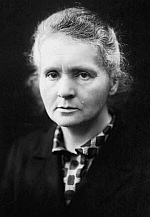
Marie Skłodowska Curie; born Maria Salomea Skłodowska 7 November 1867 – 4 July 1934) was a Polish and naturalized-French physicist and chemist who conducted pioneering research on radioactivity. She was the first woman to win a Nobel Prize, the first person and only woman to win twice, and the only person to win a Nobel Prize in two different sciences. She was part of the Curie family legacy of five Nobel Prizes. She was also the first woman to become a professor at the University of Paris, and in 1995 became the first woman to be entombed on her own merits in the Panthéon in Paris.
She was born in Warsaw, in what was then the Kingdom of Poland, part of the Russian Empire. She studied at Warsaw's clandestine Flying University and began her practical scientific training in Warsaw. In 1891, aged 24, she followed her older sister Bronisława to study in Paris, where she earned her higher degrees and conducted her subsequent scientific work. She shared the 1903 Nobel Prize in Physics with her husband Pierre Curie and physicist Henri Becquerel. She won the 1911 Nobel Prize in Chemistry.
|
| 30 | 1869 | - 1869: Transcontinental Railroad Completed
By connecting the existing eastern U.S. rail networks to the west coast, the Transcontinental Railroad (known originally as the "Pacific Railroad") became the first continuous railroad line across the United States. It was constructed between 1863 and 1869.
- 4 Mar 1869—5 Mar 1877: President Ulysses S. Grant
18th President of the United States. Born Apr. 27, 1822. Died Jul. 23, 1885 at the age of 63.
|
| 31 | 1879 | - 14 Mar 1879: Albert Einstein is born
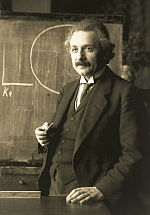
Albert Einstein was a German-born theoretical physicist, widely acknowledged to be one of the greatest and most influential physicists of all time. Einstein is best known for developing the Theory of Relativity, but he also made important contributions to the development of the theory of quantum mechanics. Relativity and quantum mechanics are the two pillars of modern physics.
|
| 32 | 1882 | - 1882: The first incandescent light bulb.

In 1880 Edison invented the first incandescent light bulb that was practical, one that would stay lit for for hours and hours. Two years later in 1882, Thomas Edison helped form the company that brought electric light to parts of Manhattan. But progress was slow. Most Americans still lit their homes with gas light and candles for another 50 years. Only in 1925 did half of all homes in the US have electric power. By the 1930s, nearly 90 percent of urban households had electricity but only 10 percent of rural households had access.
|
| 33 | 1885 | |
| 34 | 1892 | - 1 Jan 1892: Ellis Island Opens
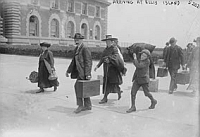
Ellis Island, in Upper New York Bay, was the gateway for over 12 million immigrants to the U.S. as the United States' busiest immigrant inspection station for over 60 years from 1892 until 1954. Ellis Island was opened January 1, 1892. The island was greatly expanded with land reclamation between 1892 and 1934. Before that, the much smaller original island was the site of Fort Gibson and later a naval magazine.
The island was made part of the Statue of Liberty National Monument in 1965 and has hosted a museum of immigration since 1990. "As a visitor to this place, you stand in awe. It has the aura of an ancient cathedral, redolent with the millions who passed through these doors."
|
| 35 | 1898 | - 21 Apr 1898—13 Aug 1898: Spanish-American War
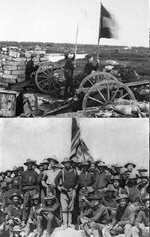
The Spanish–American War was fought between the United States and Spain in 1898. Hostilities began in the aftermath of the internal explosion of USS Maine in Havana Harbor in Cuba, leading to U.S. intervention in the Cuban War of Independence. U.S. acquisition of Spain's Pacific possessions led to its involvement in the Philippine Revolution and ultimately in the Philippine–American War.
The result was the 1898 Treaty of Paris, negotiated on terms favorable to the U.S. which allowed it temporary control of Cuba and ceded ownership of Puerto Rico, Guam, and the Philippine islands. The cession of the Philippines involved payment of $20 million ($602,320,000 today) to Spain by the U.S. to cover infrastructure owned by Spain.
|
| 36 | 1901 | - 1901: The Victor Talking Machine Company
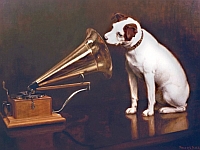
Emile Berliner, the inventor of the flat phonograph disc, sold his business to Eldridge Johnson in 1901 who created the Victor Talking Machine Company. It was in operation until 1929 when it was acquired by RCA.
The phonograph was invented in 1877 by Thomas Edison. Alexander Graham Bell's Volta Laboratory made several improvements in the 1880s and introduced the graphophone, including the use of wax-coated cardboard cylinders instead of Edison's foil cylinders
- 14 Sep 1901—4 Mar 1909: President Theodore Roosevelt
26th President of the United States. Born Oct. 27, 1858. Died Jan. 6, 1919 at the age of 61.
|
| 37 | 1903 | - 1903: First Sustained Flight
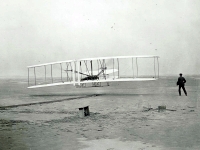
The Wright Flyer (also known as the Kitty Hawk Flyer I or the 1903 Flyer) made the first sustained flight by a manned heavier-than-air powered and controlled aircraft—an airplane—on December 17, 1903. Invented and flown by Orville and Wilbur Wright, it marked the beginning of the pioneer era of aviation.
The Wright brothers flew it four times in a location now part of the town of Kill Devil Hills, about 4 miles (6 kilometers) south of Kitty Hawk, North Carolina. The airplane flew 852 ft (260 m) on its fourth and final flight, but was damaged on landing, and minutes later powerful gusts blew it over, wrecking it.
|
| 38 | 1908 | - 1 Oct 1908: The Ford Model T
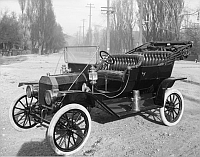
The Ford Model T is an automobile that was produced by the Ford Motor Company from October 1, 1908, to May 26, 1927. It is generally regarded as the first affordable automobile, which made car travel available to middle-class Americans. The relatively low price was partly the result of Ford's efficient fabrication, including assembly line production instead of individual handcrafting. It was mainly designed by an American (Childe Harold Wills) and two Hungarian engineers (Joseph A. Galamb, Eugene Farkas). The Model T was colloquially known as the "Tin Lizzie", "Leaping Lena" or "flivver".
|
| 39 | 1910 | - 1910: Phones in households
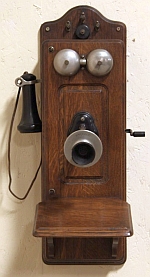
By about 1880, almost 49,000 telephones were in use. By 1900 there were nearly 600,000 phones in Bell’s telephone system; that number shot up to 2.2 million phones by 1905, and 5.8 million by 1910, mainly in large cities. The US population was over 92 million in 1910 so still a small percentage of households had phones. It wasn't until after World War II that rural homes had phone service.
|
| 40 | 1912 | - 15 Apr 1912: The Titanic Sinks
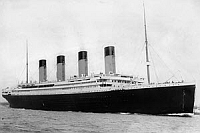
RMS Titanic sank in the early morning of 15 Apr 1912, 4 days into its maiden voyage from Southampton to New York. The largest liner in service at the time, her sinking killed over 1,500 people, one of the deadliest peacetime maritime disasters in history. The disaster caused widespread outrage over the lack of lifeboats, lax regulations, and unequal treatment of the 3 passenger classes during evacuation.
|
| 41 | 1913 | |
| 42 | 1914 | - 1914—1918: World War I
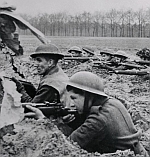
World War I, also known as the First World War or the Great War, was a global war originating in Europe. Contemporaneously described as "the war to end all wars", it led to the mobilization of more than 70 million military personnel, including 60 million Europeans, making it one of the largest wars in history. It was also one of the deadliest conflicts in history; an estimated nine million combatants and seven million civilians died as a direct result of the war, while resulting genocides and the 1918 influenza pandemic caused another 50 to 100 million deaths worldwide.
- 1 Jan 1914: World's first scheduled passenger airline service
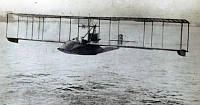
On Jan. 1, 1914, the world's first scheduled passenger airline service took off from St. Petersburg, FL and landed at its destination in Tampa, FL, about 17 miles (27 kilometers) away, with a fly time of 23 minutes. The first flight's pilot was Tony Jannus, an experienced test pilot and barnstormer. The first paying passenger was Abram C. Pheil, former mayor of St. Petersburg.
At that time, a trip between the two cities, sitting on opposite sides of Tampa Bay, took two hours by steamship or up to 12 hours by rail. Traveling by automobile around the bay took about 20 hours. But a flight would take about 20 minutes.
|
| 43 | 1915 | - 25 Jan 1915: First transcontinental telephone call
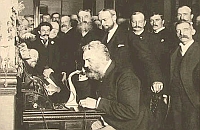
The original long-distance telephone network was started in 1885 in New York City. By 1892 this line reached Chicago. After introducing loading coils in 1899, the long-distance line continued west, and by 1911 it reached Denver, Colorado. On June 17, 1914, after affixing 4,750 miles (7,640 km) of telephone line, workers raised the final pole at Wendover, Utah. Then, Theodore Vail, the president of AT&T, succeeded in transmitting his voice across the continental U.S. in July 1914.
Six months later, Alexander Graham Bell in New York City, repeated his famous statement "Mr. Watson, come here. I want you," into the telephone, which was heard by his assistant Thomas Augustus Watson in San Francisco, for a long-distance call of 3,400 miles (5,500 km). Watson replied, "It will take me five days to get there now!" The Alexander Graham Bell call officially initiated AT&T's transcontinental service.
|
| 44 | 1918 | - 4 Mar 1918—1920: Spanish Flu Pandemic
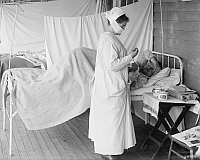
The 1918 flu pandemic, also known as the Great Influenza epidemic or by the common misnomer of the Spanish flu, was an exceptionally deadly global influenza pandemic. The earliest documented case was March 1918 in Kansas, United States, with further cases recorded in France, Germany and the United Kingdom in April. Two years later, nearly a third of the global population, or an estimated 500 million people, had been infected in four successive waves. Estimates of deaths range from 17 million to 50 million and possibly as high as 100 million, making it one of the deadliest pandemics in history.
|
| 45 | 1920 | - 18 Aug 1920: Women's Right to Vote
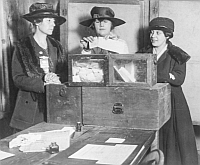
Passed by Congress June 4, 1919, and ratified on August 18, 1920, the 19th amendment granted women the right to vote. The 19th amendment legally guarantees American women the right to vote. Achieving this milestone required a lengthy and difficult struggle—victory took decades of agitation and protest.
|
| 46 | 1926 | - 26 Jan 1926: First Working Television System
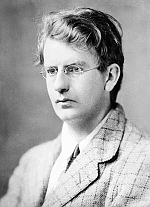
John Logie Baird (13 Aug 1888 – 14 Jun 1946) was a Scottish engineer, innovator, one of the inventors of the mechanical television, demonstrating the first working television system on 26 January 1926, and inventor of both the first publicly demonstrated color television system, and the first purely electronic color television picture tube.
In 1928 the Baird Television Development Company achieved the first transatlantic television transmission. Baird's early technological successes and his role in the practical introduction of broadcast television for home entertainment have earned him a prominent place in television's history.
|
| 47 | 1929 | - 15 Jan 1929—4 Apr 1968: Martin Luther King, Jr. is born
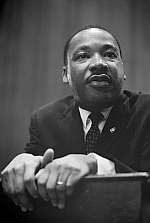
Martin Luther King Jr. was an American Baptist minister and activist, one of the most prominent leaders in the civil rights movement from 1955 until his assassination in 1968. An African-American church leader and a son of early civil rights activist and minister Martin Luther King Sr., King advanced civil rights for people of color in the United States through nonviolence and civil disobedience. Inspired by his Christian beliefs and the nonviolent activism of Mahatma Gandhi, he led targeted, nonviolent resistance against Jim Crow laws and other forms of discrimination.
- 4 Mar 1929—4 Mar 1933: President Herbert Hoover
31st President of the United States. Born August 10, 1874. Died October 20, 1964 at the age of 90.
- 29 Oct 1929—1939: The Great Depression
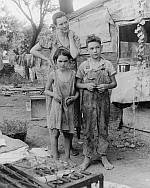
The Great Depression started in the United States after a major fall in stock prices that began around September 4, 1929, and became worldwide news with the stock market crash of October 29, 1929 (known as Black Tuesday). Between 1929 and 1932, worldwide gross domestic product (GDP) fell by an estimated 15%. By comparison, worldwide GDP fell by less than 1% from 2008 to 2009 during the Great Recession. Some economies started to recover by the mid-1930s. However, in many countries the negative effects of the Great Depression lasted until the beginning of World War II.
|
| 48 | 1930 | - 1930—1935: The Golden Age of Radio
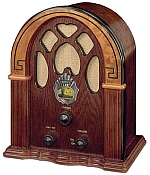
Radio broadcasting was the cheapest form of entertainment, and it provided the public with far better entertainment than most people were accustomed to. As a result, its popularity grew rapidly in the late 1920s and early 1930s, and by 1934, 60 percent of the nation’s households had radios. One and a half million cars were also equipped with them. The 1930s were the Golden Age of radio. It was so popular that theaters dared not open until after the extremely popular “Amos ‘n Andy” show was over.
|
| 49 | 1932 | - 20 May 1932: Amelia Earhart's flight across the Atlantic
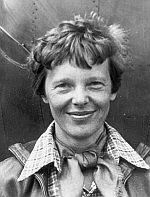
On this day, Amelia Earhart (born 24 Jul 1897) becomes the first woman to fly solo across the Atlantic, taking 15 hours 18 minutes. In August she then became the first woman to fly non-stop across the US, from Los Angeles to Newark.
Amelia was attempting to fly around the world in 1937 when she disappeared on July 2, 1937 and was presumed dead.
|
| 50 | 1933 | |
| 51 | 1939 | - 1939: First publicly accessible television broadcast

During the 1939 World's Fair David Sarnoff, president of RCA, unveiled the first commercial publicly accessible television broadcast. In Flushing NY, he proclaimed "Now we add sight to sound" and during the opening ceremonies of the fair on April 30th, FDR became the first president to ever be televised. TV sets went on sale to the public the very next day, and RCA/NBC began regular broadcasts on a daily basis. By the end of the 30s, there were a few hundred televisions in America.
By 1948, 2 million television sets were in American homes (of which 720,000 were in New York City alone.) On September 4th, 1951 the first coast-to-coast telecast was aired as President Truman spoke to 13 million television sets.
- 3 Sep 1939—2 Sep 1945: World War II
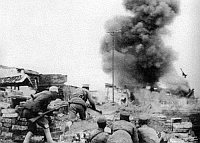
World War II or the Second World War, often abbreviated as WWII or WW2, was a global conflict that lasted from 1939 to 1945. The vast majority of the world's countries, including all of the great powers, fought as part of two opposing military alliances: the Allies (lead by the Soviet Union, United Kingdom, United States and China) and the Axis (lead by Germany, Japan, and Italy). Many participants threw their economic, industrial, and scientific capabilities behind this total war, blurring the distinction between civilian and military resources. Aircraft played a major role, enabling the strategic bombing of population centres and the only two nuclear weapons ever used in war.
World War II was by far the deadliest conflict in human history; it resulted in 70 to 85 million fatalities, mostly among civilians. Tens of millions died due to genocides (including the Holocaust), starvation, massacres, and disease.
|
| 52 | 1941 | - 24 May 1941: Bob Dylan is born
Bob Dylan (born Robert Allen Zimmerman, May 24, 1941) is an American singer-songwriter. Often regarded as one of the greatest songwriters of all time, Dylan has been a major figure in popular culture during a career spanning more than 60 years. Much of his most celebrated work dates from the 1960s, when songs such as "Blowin' in the Wind" (1963) and "The Times They Are a-Changin'" (1964) became anthems for the civil rights and antiwar movements.
- 7 Dec 1941: Pearl Harbor is bombed
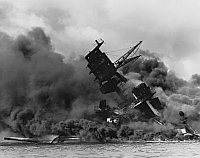
The attack on Pearl Harbor was a surprise military strike by the Imperial Japanese Navy Air Service against the United States naval base at Pearl Harbor, Hawaii Territory, on the morning of December 7, 1941.
The surprise attack came as a profound shock to the American people and led directly to the American entry into World War II in both the Pacific and European theatres. There were precedents for unannounced military action by Japan, but the lack of any formal warning, particularly while negotiations were still apparently ongoing, led President Franklin D. Roosevelt to proclaim December 7, 1941, "a date which will live in infamy". Because the attack happened without a declaration of war and without explicit warning, the attack on Pearl Harbor was later judged in the Tokyo Trials to be a war crime.
|
| 53 | 1942 | - 1942: Mass production of penicillin
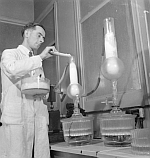
On March 14, 1942, the first patient was treated for streptococcal sepsis with US-made penicillin produced. Half of the total supply produced at the time was used on that one patient, Anne Miller. By June 1942, just enough US penicillin was available to treat ten patients. As a direct result of the WWII and the War Production Board, by June 1945, over 646 billion units per year were being produced.
|
| 54 | 1945 | |
| 55 | 1950 | |
| 56 | 1953 | - 1953—1977: Elvis Presley
Elvis Aaron Presley (January 8, 1935 – August 16, 1977), often referred to mononymously as Elvis, was an American singer and actor. Dubbed the "King of Rock and Roll", he is regarded as one of the most significant cultural figures of the 20th century.
- 20 Jan 1953—20 Jan 1961: President Dwight D. Eisenhower
34th President of the United States. Born October 14, 1890. Died March 28, 1969 at the age of 79.
|
| 57 | 1954 | - 1954—1968: Civil Rights Movement
The civil rights movement was a nonviolent social and political movement and campaign from 1954 to 1968 in the United States to abolish legalized institutional racial segregation, discrimination, and disenfranchisement throughout the United States. The movement had its origins in the Reconstruction era during the late 19th century, although it made its largest legislative gains in the 1960s after years of direct actions and grassroots protests. The social movement's major nonviolent resistance and civil disobedience campaigns eventually secured new protections in federal law for the civil rights of all Americans.
- Apr 1954: First mass produced color TV
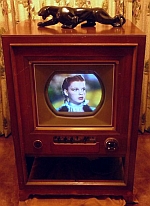
The RCA CT-100 was an early all-electronic consumer color television introduced in April 1954. The color picture tube measured 15 inches diagonally. The viewable picture was just 11½ inches wide. The CT-100 wasn't the world's first color TV, but it was the first to be mass produced, with 4400 having been made.
|
| 58 | 1955 | - 1955: Vaccine for Polio
Before a polio vaccine became available, several polio epidemics had occurred between 1948 and 1955. In 1955 Dr. Jonas E. Salk and colleagues research and develop a polio vaccine.
- 1 Nov 1955—30 Apr 1975: Vietnam War
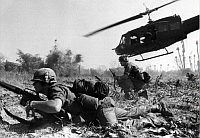
The Vietnam War was a conflict in Vietnam, Laos, and Cambodia from 1 November 1955 to the fall of Saigon on 30 April 1975. It was the second of the Indochina Wars and was officially fought between North Vietnam and South Vietnam. The north was supported by the Soviet Union, China, and other communist states, while the south was supported by the United States and other anti-communist allies. The war is widely considered to be a Cold War-era proxy war. It lasted almost 20 years, with direct U.S. involvement ending in 1973. The conflict also spilled over into neighboring states, exacerbating the Laotian Civil War and the Cambodian Civil War, which ended with all three countries becoming communist states by 1975.
|
| 59 | 1959 | - 25 Jan 1959: First scheduled transcontinental passenger flight
On Jan. 25, 1959, the first scheduled transcontinental passenger jet flight took place, a non-stop American Airlines trip from California to New York.
|
| 60 | 1960 | - 1960—1970: The Beatles
The Beatles were an English rock band, formed in Liverpool in 1960, that was comprised of John Lennon, Paul McCartney, George Harrison and Ringo Starr. They are regarded as the most influential band of all time
|
| 61 | 1961 | |
| 62 | 1963 | |

 1764 - 1842 (78 years)