| |
Date |
Event(s) |
| 1 | 1835 | - 30 Nov 1835—21 Apr 1918: Mark Twain is born
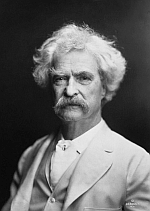
Samuel Langhorne Clemens (November 30, 1835 – April 21, 1910), known by his pen name Mark Twain, was an American writer, humorist, entrepreneur, publisher, and lecturer. He was praised as the "greatest humorist the United States has produced", and William Faulkner called him "the father of American literature". His novels include The Adventures of Tom Sawyer (1876) and its sequel, Adventures of Huckleberry Finn (1884), the latter of which has often been called the "Great American Novel".
|
| 2 | 1847 | - 11 Feb 1847—18 Oct 1931: Thomas Edison is born
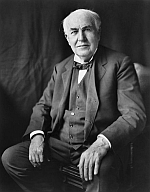
Thomas Alva Edison (February 11, 1847 – October 18, 1931) was an American inventor and businessman. He developed many devices in fields such as electric power generation, mass communication, sound recording, and motion pictures.[4] These inventions, which include the phonograph, the motion picture camera, and early versions of the electric light bulb, have had a widespread impact on the modern industrialized world.
- 3 Mar 1847—2 Aug 1922: Alexander Graham Bell is born
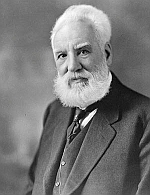
Alexander Graham Bell was a Scottish-born scientist, inventor, engineer, and innovator who is credited with inventing and patenting the first practical telephone. He also founded the American Telephone and Telegraph Company (AT&T) in 1885.
Bell's father, grandfather, and brother had all been associated with work on elocution and speech and both his mother and wife were deaf, profoundly influencing Bell's life's work. His research on hearing and speech further led him to experiment with hearing devices which eventually culminated in Bell being awarded the first U.S. patent for the telephone in 1876. Bell considered his invention an intrusion on his real work as a scientist and refused to have a telephone in his study.
|
| 3 | 1913 | |
| 4 | 1914 | - 1914—1918: World War I

World War I, also known as the First World War or the Great War, was a global war originating in Europe. Contemporaneously described as "the war to end all wars", it led to the mobilization of more than 70 million military personnel, including 60 million Europeans, making it one of the largest wars in history. It was also one of the deadliest conflicts in history; an estimated nine million combatants and seven million civilians died as a direct result of the war, while resulting genocides and the 1918 influenza pandemic caused another 50 to 100 million deaths worldwide.
|
| 5 | 1918 | - 4 Mar 1918—1920: Spanish Flu Pandemic

The 1918 flu pandemic, also known as the Great Influenza epidemic or by the common misnomer of the Spanish flu, was an exceptionally deadly global influenza pandemic. The earliest documented case was March 1918 in Kansas, United States, with further cases recorded in France, Germany and the United Kingdom in April. Two years later, nearly a third of the global population, or an estimated 500 million people, had been infected in four successive waves. Estimates of deaths range from 17 million to 50 million and possibly as high as 100 million, making it one of the deadliest pandemics in history.
|
| 6 | 1920 | - 18 Aug 1920: Women's Right to Vote
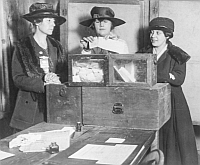
Passed by Congress June 4, 1919, and ratified on August 18, 1920, the 19th amendment granted women the right to vote. The 19th amendment legally guarantees American women the right to vote. Achieving this milestone required a lengthy and difficult struggle—victory took decades of agitation and protest.
|
| 7 | 1926 | - 26 Jan 1926: First Working Television System
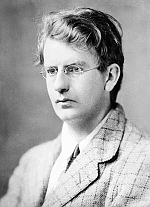
John Logie Baird (13 Aug 1888 – 14 Jun 1946) was a Scottish engineer, innovator, one of the inventors of the mechanical television, demonstrating the first working television system on 26 January 1926, and inventor of both the first publicly demonstrated color television system, and the first purely electronic color television picture tube.
In 1928 the Baird Television Development Company achieved the first transatlantic television transmission. Baird's early technological successes and his role in the practical introduction of broadcast television for home entertainment have earned him a prominent place in television's history.
|
| 8 | 1929 | - 15 Jan 1929—4 Apr 1968: Martin Luther King, Jr. is born
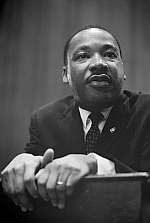
Martin Luther King Jr. was an American Baptist minister and activist, one of the most prominent leaders in the civil rights movement from 1955 until his assassination in 1968. An African-American church leader and a son of early civil rights activist and minister Martin Luther King Sr., King advanced civil rights for people of color in the United States through nonviolence and civil disobedience. Inspired by his Christian beliefs and the nonviolent activism of Mahatma Gandhi, he led targeted, nonviolent resistance against Jim Crow laws and other forms of discrimination.
- 4 Mar 1929—4 Mar 1933: President Herbert Hoover
31st President of the United States. Born August 10, 1874. Died October 20, 1964 at the age of 90.
- 29 Oct 1929—1939: The Great Depression

The Great Depression started in the United States after a major fall in stock prices that began around September 4, 1929, and became worldwide news with the stock market crash of October 29, 1929 (known as Black Tuesday). Between 1929 and 1932, worldwide gross domestic product (GDP) fell by an estimated 15%. By comparison, worldwide GDP fell by less than 1% from 2008 to 2009 during the Great Recession. Some economies started to recover by the mid-1930s. However, in many countries the negative effects of the Great Depression lasted until the beginning of World War II.
|
| 9 | 1930 | - 1930—1935: The Golden Age of Radio

Radio broadcasting was the cheapest form of entertainment, and it provided the public with far better entertainment than most people were accustomed to. As a result, its popularity grew rapidly in the late 1920s and early 1930s, and by 1934, 60 percent of the nation’s households had radios. One and a half million cars were also equipped with them. The 1930s were the Golden Age of radio. It was so popular that theaters dared not open until after the extremely popular “Amos ‘n Andy” show was over.
|
| 10 | 1932 | - 20 May 1932: Amelia Earhart's flight across the Atlantic

On this day, Amelia Earhart (born 24 Jul 1897) becomes the first woman to fly solo across the Atlantic, taking 15 hours 18 minutes. In August she then became the first woman to fly non-stop across the US, from Los Angeles to Newark.
Amelia was attempting to fly around the world in 1937 when she disappeared on July 2, 1937 and was presumed dead.
|
| 11 | 1933 | |

 1918 - 1936 (18 years)